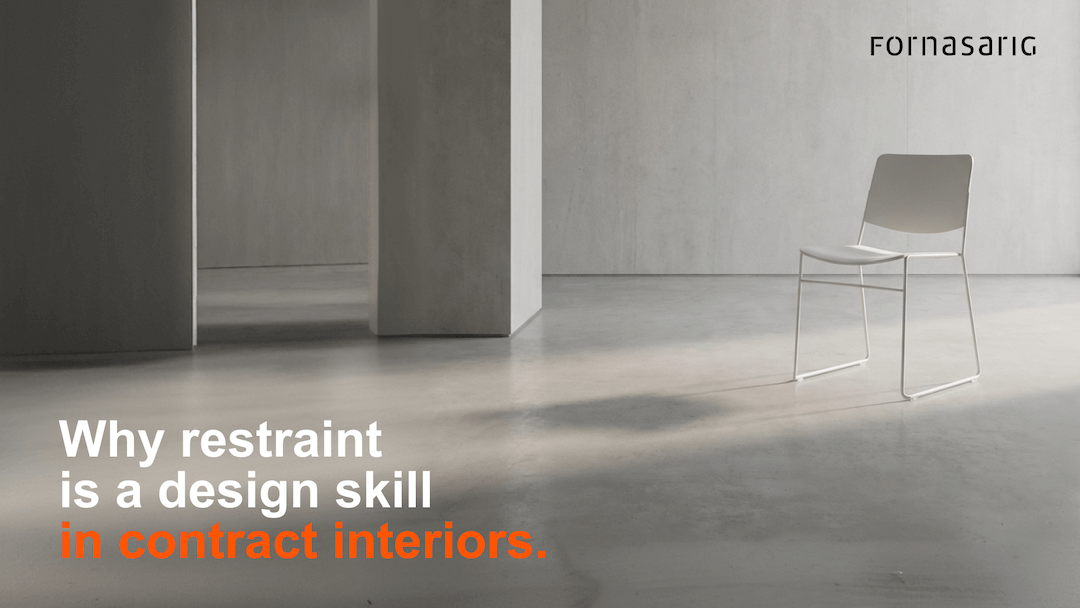
Why restraint is the quiet skill behind memorable contract interiors
In contract interiors, restraint is not aesthetic minimalism. It is risk management.
When spaces are overdesigned, they often age faster. Materials compete, forms dominate, and visual noise increases maintenance complexity. Over time, this creates aesthetic fatigue and higher operational costs. For decision‑makers, this is not a stylistic issue. It is a strategic one.
Restraint, instead, protects coherence. It allows architecture, circulation, and function to remain legible even as layouts evolve. This matters in environments that change configuration frequently, such as education, hospitality, and corporate settings. In these contexts, furniture must support transformation without becoming the focus of it.
At Fornasarig, restraint translates into structural clarity, balanced proportions, and material honesty. Our seating systems are engineered to remain visually calm while performing under intensive use. The result is not less design, but better design discipline.
Because memorable interiors are rarely those that shout. They are the ones that endure.
When too much design silently sabotages your space
Complex geometries increase cleaning time. Fragile detailing accelerates wear. Decorative elements that attract attention on opening day may become visual distractions after months of daily use. What appears expressive at the beginning can quickly turn into a liability.
This is particularly evident in multi‑purpose spaces. When rooms transition from lecture to event, from dining to assembly, furniture must move efficiently. Stackability, weight, and structural balance become operational variables. If seating is visually heavy or technically inefficient, reconfiguration slows down.
Restraint reduces these hidden costs.
By prioritising essential structure over decorative excess, contract seating becomes easier to handle, easier to maintain, and easier to integrate across different layouts. This is not a theoretical benefit. It directly impacts labour time, storage optimisation, and lifecycle value.
In other words, restraint protects both aesthetic integrity and operational efficiency.
How restraint turns contemporary seating into long‑term assets
Restraint becomes tangible when translated into product engineering. Take adaptable learning environments as an example. Spaces must accommodate lectures, group work, and events without visual or logistical disruption. In these contexts, seating must be lightweight, stackable, and structurally reliable.
Fornasarig seating systems are developed with this in mind. Stackability is not an accessory feature. It is integrated into the design logic. Weight is calibrated to allow easy handling. Ergonomic curves are shaped to ensure comfort during extended sessions. Materials are selected for durability under repeated movement and storage.
These choices reduce replacement cycles. They simplify storage. They maintain visual coherence even after years of intensive use. When institutions reorder seating years after an initial installation, it reflects more than aesthetic appreciation. It signals long‑term performance satisfaction.
Restraint, therefore, transforms seating from a purchase into an asset.
Designing spaces that endure, not just impress on opening night
Contract design often faces a silent tension: the desire to impress versus the need to endure. Impressive spaces attract attention at inauguration. Enduring spaces support daily reality.
Restraint aligns design with longevity. It ensures that materials age gracefully, that proportions remain balanced as trends shift, and that furniture continues to integrate naturally within evolving layouts. This approach reduces redesign pressure and protects investment value.
For over a century, Fornasarig has approached seating as part of a broader spatial ecosystem. Products are not conceived as isolated objects but as structural components within architecture. Durability, adaptability, and clarity guide every development decision.
Because in contract environments, design must perform quietly for years.
Restraint is not the absence of expression.
It is the discipline that allows spaces to function, adapt, and remain relevant long after the opening night applause fades.