The essence of well-designed stackable chairs
In contemporary contract design, stackable chairs are an expression of intelligent functionality. In workplaces, universities, and hospitality environments, furniture must adapt as quickly as the people who use it. Flexibility is no longer a luxury; it is an operational necessity and a symbol of smart spatial design.
For this reason, a well-designed stackable chair combines several qualities: lightness, strength, and the ability to occupy minimal space without sacrificing comfort or visual harmony.
This is exactly what Fornasarig’s seating solutions offer.
The balance between ergonomics and efficiency also defines the way people experience their surroundings. The balance between ergonomics and efficiency defines how people experience the environment around them. Because chairs that can be stacked easily make it possible to transform spaces in seconds, moving from one configuration to another without losing rhythm or precision.
Meanwhile, ergonomic shape, stable structure, and durable materials, these are the invisible components that distinguish a professional chair from a simple seat. When design meets such technical mastery, even the smallest detail becomes an enabler of comfort, productivity, and flow. Stackable chairs express the union of functionality and design; they move with people and adapt to the rhythm of contemporary life.
These principles are exactly what Fornasarig has been applying in the development of its collections since 1878. Every piece is conceived with the same dual objective: to be beautiful when used individually, and efficient when grouped or stored. The Link 60X is the emblematic example of this design: ergonomic, beautiful, and above all, the most stackable chair in the world in less than two meters.
In Fornasarig’s vision, stacking is a gesture of design intelligence and for this reason each project starts from a deep understanding of how people move and interact with space, turning practicality into an aesthetic language that defines modern environments.
When stackability becomes strategic: real-world applications
In contemporary contract environments, stackability is not an abstract design feature. It becomes measurable when spaces must adapt quickly, accommodate high user turnover, and maintain visual coherence over time.
The following case studies illustrate how intelligent seating systems support flexibility in both educational and research-driven contexts.
NOI Techpark Bruneck: a dynamic environment that demands flexibility
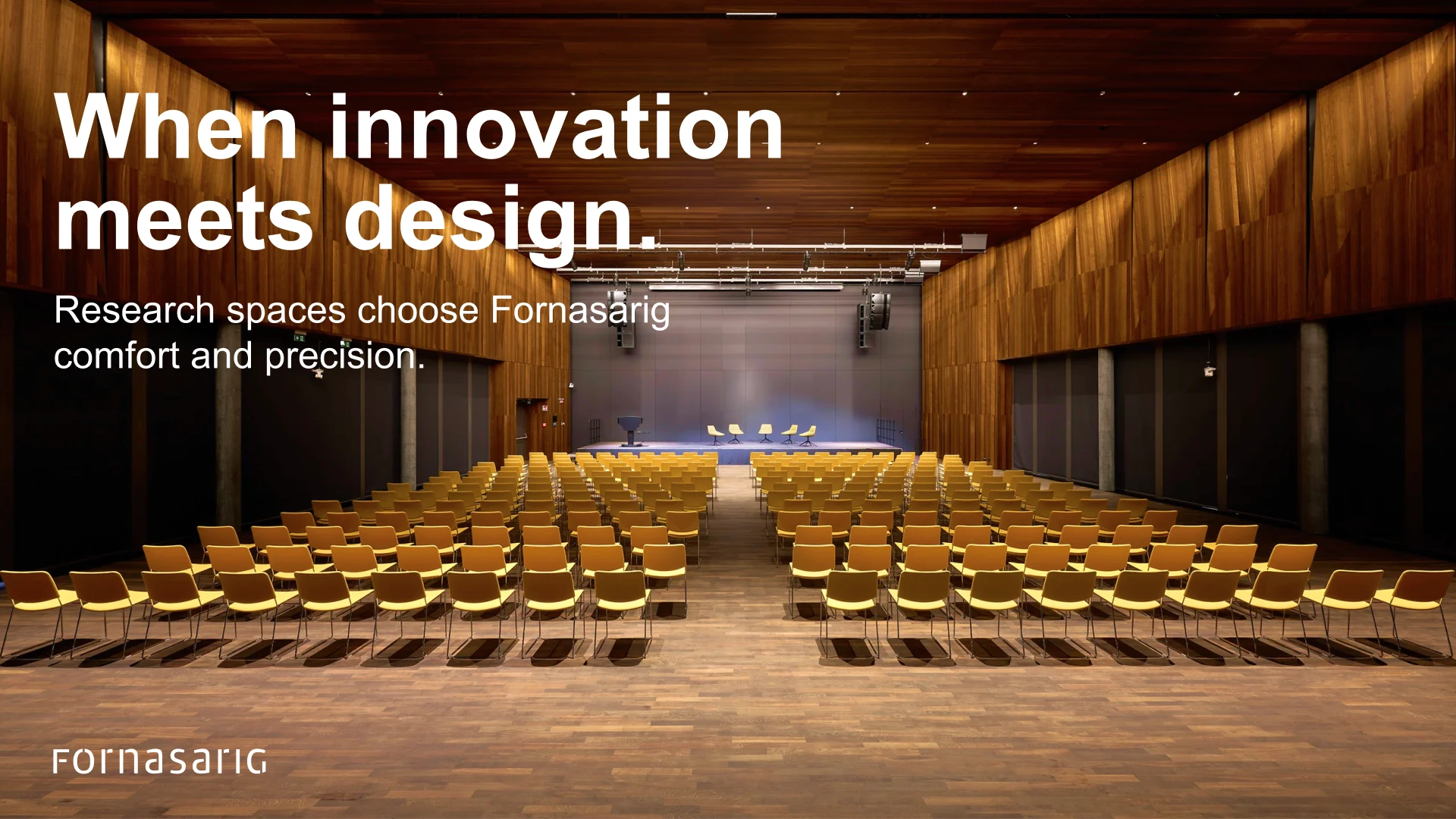
At NOI Techpark Bruneck, architecture serves innovation. The building was designed to host laboratories, start-ups, and research departments, creating an open ecosystem where knowledge and creativity coexist. Every room, corridor, and shared area needed furniture that could follow this same rhythm, versatile, durable, and consistent in style.
Therefore such an environment, static furniture would have been a contradiction. For this reason was fundamental to find a seating system capable of adapting quickly to changing layouts, from training sessions to presentations, while ensuring long-term comfort and coherence across multiple spaces. So, the project required a product that could reflect the spirit of the place: clean, technical, and human.
Indeed, in innovation centers like NOI Techpark, furnishings must adapt at the same speed as ideas. Design flexibility becomes part of the architecture’s DNA, allowing people to transform spaces without interrupting the natural flow of work and communication. For this reason, the architects selected Link 60X by Fornasarig, a symbol of Italian flexibility and precision, in both polyolefin resin and padded versions.
The polyolefin resin variant offers lightness and wear resistance and was chosen for high-traffic rooms. The padded variant, on the other hand, adds acoustic softness and tactile comfort for longer sessions, which is why it was chosen for the conference room. Each version maintains the same proportions and visual balance, ensuring continuity across multiple spaces.
This design flexibility reflects the values of NOI Techpark itself: a place where disciplines overlap and each space can evolve without losing harmony. Through intelligent engineering and timeless design, Fornasarig’s Link 60X demonstrates that mobility and elegance can coexist seamlessly in modern architecture.
University of Chicago Booth School of Business: continuity as performance proof
In 2019, the University of Chicago Booth School of Business selected Fornasarig Link Shell for its London campus learning spaces. The brief required seating capable of supporting executive education programs, where sessions are intensive and layouts frequently adjusted.
Five years later, at the end of 2024, the institution expanded its installation with more than 150 additional units.
This continuity matters…
Executive education environments operate under specific pressures. Rooms must accommodate lectures, workshops, networking sessions, and hybrid formats. Seating is constantly moved, stacked, stored, and repositioned. In this context, stackability is not about convenience. It is about operational reliability.
Link Shell responds to these demands through structural clarity and functional precision. The curved oak plywood shell, shaped using 3D technology, ensures both ergonomic support and visual lightness. The waterfall seat facilitates leg movement during long sessions. The backrest curvature improves comfort without adding visual bulk.
When an institution chooses to extend an installation years after the initial project, it signals sustained performance. In high-performance learning environments, stackable seating is not a temporary solution. It becomes part of the spatial infrastructure.
Montclair Kimberley Academy: stackability as spatial strategy
At Montclair Kimberley Academy in New Jersey, flexibility was not a secondary feature of the project. It was the starting point.
The expansion of the Primary School introduced a new multi-purpose environment, a “cafetorium” designed to function as a 400-seat assembly hall. Through a large movable partition, the space can be divided into a 150-seat performance area and a 100-student dining space. In practical terms, this means that the room must transition smoothly between very different configurations, sometimes within the same day.
In this context, stackable chairs are structural tools that make transformation possible.
Seating must be lightweight enough for quick handling, stable enough for large assemblies, and visually discreet enough to integrate into a space used by young students, teachers, and guests alike. Operational efficiency becomes inseparable from spatial clarity.
Fornasarig’s stackable seating systems respond precisely to these demands. Designed for intensive contract use, they combine structural durability with ease of storage and reconfiguration. Stackability reduces storage footprint. Controlled weight improves handling speed. Balanced proportions preserve visual order even in dynamic layouts.
This is where intelligent functionality becomes visible.
When educational spaces are designed to support movement, performance, dining, and learning without friction, stackable chairs cease to be background elements. They become enabling infrastructure.
The MKA project demonstrates how thoughtful seating design can support architectural flexibility while maintaining coherence and long-term durability. In environments where daily transformation is part of the program, stackability is not an accessory feature. It is a strategic necessity.
Link 60X: a study in balance and precision
The Link 60X embodies Fornasarig’s philosophy of transforming technical intelligence into elegant simplicity. Designed for versatility, it balances structural strength, comfort, and minimalism — three qualities that define modern contract seating. Every curve and connection is the result of careful engineering and a deep understanding of human posture.
Its slender metal sled base conveys a sense of lightness, yet it hides exceptional durability. The tubular steel, calibrated for strength and resilience, supports the body without visual weight.
Comfort is never a secondary consideration for Fornasarig, but rather central to the identity of Link 60X. The seat’s waterfall front edge gently relieves pressure from the legs, improving circulation during long use. The double curve backrest follows the body’s natural curve, supporting the lumbar area and promoting correct posture. Each element works together to encourage relaxed attentiveness, even during long sessions.
A distinctive feature of Link 60X is to be stacked up to sixty units per trolley in less than two meters. This efficiency makes it a favorite in dynamic settings, where spaces need to be reconfigured quickly without sacrificing aesthetics.
In Link 60X, every technical solution becomes part of the design language. From the silent glide of its base to the seamless junctions of its frame, the chair demonstrates how form can express purpose. Ergonomics and engineering merge to create a product that feels effortless yet performs with precision.
Through Link 60X, Fornasarig proves that even a stackable chair can embody timeless design. It adapts, performs, and endures, reflecting the company’s belief that true innovation lies in the invisible details that enhance human experience.
A legacy of design shaping today’s spaces
Projects like NOI Techpark Bruneck and Montclair Kimberley Academy belong to the series of legacy case histories that shaped Fornasarig’s international reputation. They represent moments in time where technical intelligence and aesthetic clarity converged to create enduring value. Even years later, these projects continue to inspire new collections and collaborations around the world.
In fact, each installation reflects a core belief: that good design is timeless when it serves people. From research centers to universities and hospitality venues, Fornasarig chairs connect cultures through a universal design language; one built on functionality, sustainability, and emotion. The company’s 145-year heritage is not a story of repetition, but of evolution.
Other projects reinforce this narrative. In the Scandic Sortland Hotel, design becomes a form of hospitality, where comfort welcomes travelers before words do. At La Rochette, the warmth of wood transforms quiet interiors into spaces of serenity and balance. These examples, different in context but united in spirit, demonstrate how Fornasarig’s approach consistently translates architectural ideas into living experiences.
Indeed, every chair is the outcome of research, dialogue, and craftsmanship. Behind its clean geometry lies a network of designers, engineers, and artisans who share a single goal: to make beauty tangible and durable. Across generations, this vision has guided the company’s evolution from local workshop to international reference point in contract design.
Fornasarig’s commitment to sustainable materials, modular systems, and repairable components further strengthens its role in shaping the future of design. The company continues to collaborate with architects and developers who seek furniture capable of withstanding time, use, and trends.
In today’s rapidly changing world, these values make a difference. Fornasarig chairs remind us that intelligent design never goes out of style, it adapts, performs, and endures.