Design Chairs for Hospitality: where comfort defines experience
Design chairs for hospitality are the first, silent signal guests read when they enter a space. They set expectations, modulate behaviour, and quietly organize movement. Architects design volumes; chairs define how those volumes will be used. Therefore the brief for any hospitality project begins with a question of human scale: how will people sit, wait, dine, and gather?
Fornasarig approaches that question as a design problem and as an operational one. The brand believes in pieces that perform technically and speak emotionally. Indeed, design chairs must be durable, ergonomic, and easy to manage because they shape how spaces function and how people feel.
At the same time, hospitality demands versatility. Rooms change purpose during a single day; a breakfast area can become a co-working space, a conference hall can become a banquet venue. Consequently, chairs must combine stackability, lightness, and comfort without compromising aesthetics. In this perspective, material choices and construction details become decisive: a bentwood frame must read warm; a metal sled base must read refined. Moreover, finishes and textiles must age gracefully under heavy use.
Eurostars Cascais is a great exeample of Fornasarig skill in the hospitality world. This hotel needed to create a coherent seating language that resonates with the ocean view and the hotel’s contemporary character. In practice, this meant selecting models that balance presence and restraint, that are easily configured, and that deliver long-term comfort for guests and staff alike.
Eurostars Cascais: design dialogue between sea and space
At the Eurostars Cascais Hotel, overlooking the restless Atlantic Ocean, design finds its rhythm in the movement of the ocean. Every space — from the restaurant to the guest rooms — was conceived as part of a single visual horizon. The goal was not only to furnish but to translate the landscape into atmosphere, allowing guests to feel the architecture through comfort.
The renovation of this pre-existing structure reflected a precise architectural intention: to open the building to the sea while preserving a sense of intimacy. Clean lines, soft textures, and natural light form a neutral backdrop for human experience. Within this balance, seating became the silent mediator — functional, elegant, and tactile — capable of expressing comfort before it is consciously perceived.
Fornasarig’s role was to articulate this vision with furniture that could meet diverse spatial needs while maintaining stylistic coherence. The brand’s wide range of collections made it possible to furnish every area with different characters yet a single identity. In the restaurant, lounge, and guest rooms, chairs were chosen not as decorative objects but as instruments of hospitality — bridges between design and human gesture.
The tactile contrast of materials defines the project’s sensibility: the warmth of beechwood, the structural clarity of steel, the softness of upholstery.
From a design perspective, this triad shows how Fornasarig uses materials as narrative instruments rather than decorative ones — each surface chosen to express function and emotion simultaneously. These textures echo the landscape outside — fluid yet stable, refined yet welcoming. Design, in this context, becomes a quiet form of dialogue: between light and matter, between the calm horizon and the precision of craft.
Ultimately, Eurostars Cascais embodies Fornasarig’s philosophy: that hospitality design should never dominate space, but reveal it — through proportion, harmony, and enduring comfort.
Tulip, Camilla and Wolfgang Metal: a unified language of comfort
In hospitality interiors, harmony is often achieved not by uniformity but by dialogue.
At Eurostars Cascais, three Fornasarig collections — Tulip, Camilla, and Wolfgang Metal Upholstered — come together to express one vision: comfort as a form of design intelligence. Each model responds to a specific architectural context, yet all share the same design DNA — elegant, ergonomic, and enduring.
Tulip: softness and proportion
Designed by Luca Scacchetti, the Tulip armchair translates the shape of a flower into an act of gentle hospitality. Its wide, enveloping backrest and balanced proportions make it suitable for both dining and lounge areas. In the restaurant, Tulip welcomes guests with a soft embrace, enhancing the visual rhythm of the space through its sculptural silhouette.
The solid beechwood frame ensures stability and tactile warmth, while the upholstery — customizable in color and fabric — adds an intimate, domestic note to the refined environment. This combination of tactile and visual comfort exemplifies Fornasarig’s “human scale” approach — design that doesn’t dominate architecture but aligns with its rhythm.
Design that invites people to stay longer defines true hospitality.
Camilla: graphic balance and international style
Camilla, designed by Luca Fornasarig, embodies innate class.
Its bentwood backrest, slightly curved and visually light, creates a graphic dialogue between structure and textile. This distinctive interplay between solid wood and upholstery reflects the architectural language of Eurostars Cascais — clean lines, warm materials, timeless proportion.
The ergonomic inclination of the seat enhances comfort during long stays, while the overall aesthetic conveys understated luxury. Chosen for the hotel’s dining and lounge zones, Camilla adds rhythm to the interior, becoming a discreet yet powerful visual signature.
In essence, Camilla represents design that merges Italian craftsmanship with global sensibility — a synthesis of tradition and modernity.
Wolfgang Metal: contemporary precision
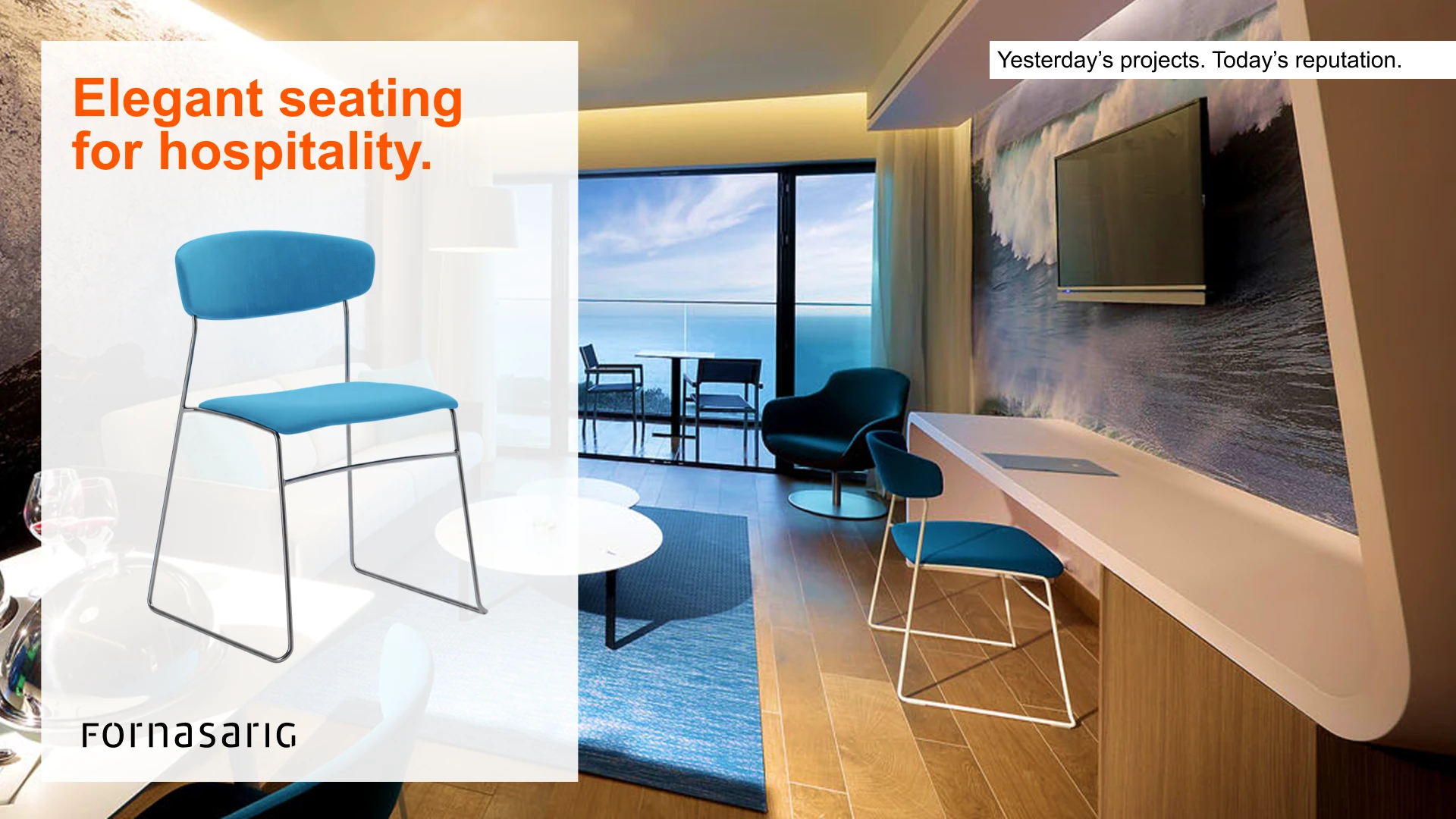
In the guest rooms, the Wolfgang Metal Upholstered chair, designed by Luca Nichetto, introduces a different tempo — lighter, more minimal, yet equally expressive.
Its sled-base frame in slender steel rod gives an impression of weightlessness, while the upholstered seat ensures long-lasting comfort. The chair’s stackability and robust structure make it ideal for professional hospitality environments where mobility and aesthetics must coexist.
Available in multiple finishes, Wolfgang Metal demonstrates the technical mastery behind Fornasarig’s collections: engineering that performs without losing elegance; structural precision expressed with visual lightness, a trait that distinguishes Italian contract design from its northern counterparts. Every curve and weld contributes to quiet refinement, reaffirming the brand’s expertise in combining ergonomics and design purity.
Together, Tulip, Camilla, and Wolfgang Metal form a coherent narrative of comfort. Each speaks its own language, yet all express Fornasarig’s design philosophy — a belief that every chair must serve space, movement, and emotion with equal grace.
Harmony between Design, Comfort and Sustainability
Design chairs for hospitality express their true value over time — not only through form, but through endurance. In Fornasarig’s philosophy, every curve, joint, and finish is part of a system designed to last. Comfort and durability are inseparable concepts in Fornasarig’s philosophy.
Behind the apparent simplicity of each chair lies a long chain of research and testing. Materials are selected not for trend, but for performance: solid beechwood from certified sources, high-resistance steel rods, and recyclable polymers developed with engineering partners and CATAS laboratories. Each element must ensure structural precision and ergonomic integrity even under intensive use.
Sustainability in design is a form of long-term intelligence.
Ergonomics also plays a central role. The natural curvature of a backrest or the waterfall edge of a seat are not aesthetic gestures but expressions of care. These details preserve circulation, improve posture, and translate technical precision into wellbeing. Thus, design becomes both function and empathy.
Fornasarig’s production methods follow the same balance between innovation and responsibility. Finishes such as chromium III and powder coatings are environmentally safe and solvent-free. This attention to process, not just product, reveals how sustainability is embedded in Fornasarig’s workflow — it is design intelligence applied to manufacturing.
Upholstery is customizable using eco-certified fabrics that age gracefully. Moreover, some chair are designed for disassembly — allowing parts to be replaced or recycled, ensuring a circular lifecycle.
In this way, Fornasarig connects craftsmanship and technology to create furniture that performs and endures.
Sustainability is not a feature; it is the framework that shapes every decision.
Ultimately, harmony between design, comfort, and sustainability defines Fornasarig’s contribution to contemporary hospitality: a design ethic that respects both people and the planet, while ensuring that beauty remains functional through time.
A Heritage of Design Shaping Modern Hospitality
Hospitality is not a trend for Fornasarig; it is a field of evolution.
For more than a century, the company has transformed craftsmanship into a language that speaks to architects and designers across cultures and time. Each project — from mountain resorts to seaside hotels — is part of a broader dialogue about what comfort means today. Good design is timeless when it serves people.
Since 1878, the family’s expertise has passed through generations of artisans, engineers, and designers who share a single vision: to build furniture that connects functionality with emotion. The result is a continuum where technology refines tradition, and every chair reflects both handcraft and research.
From a design perspective, this continuity is what ensures the brand’s longevity. Fornasarig’s collections are not defined by fashion cycles but by structural intelligence — proportions that feel balanced, materials that age gracefully and details that respond to human gestures. Such constancy allows each project to remain relevant long after its completion.
Projects like Eurostars Cascais demonstrate once again how this heritage evolves with time. The combination of Tulip, Camilla, and Wolfgang Metal reveals an ability to adapt classic principles — harmony, proportion, and comfort — to the demands of modern hospitality. Heritage becomes a living tool for innovation.
Across continents, from universities to boutique hotels, Fornasarig chairs continue to embody the same idea: that beauty must endure through use. In a world of fast consumption, durability is an act of cultural responsibility.
Through its heritage of craftsmanship and vision for modern spaces, Fornasarig continues to design furniture that moves with people and endures through time — shaping not only interiors, but the very experience of hospitality itself.