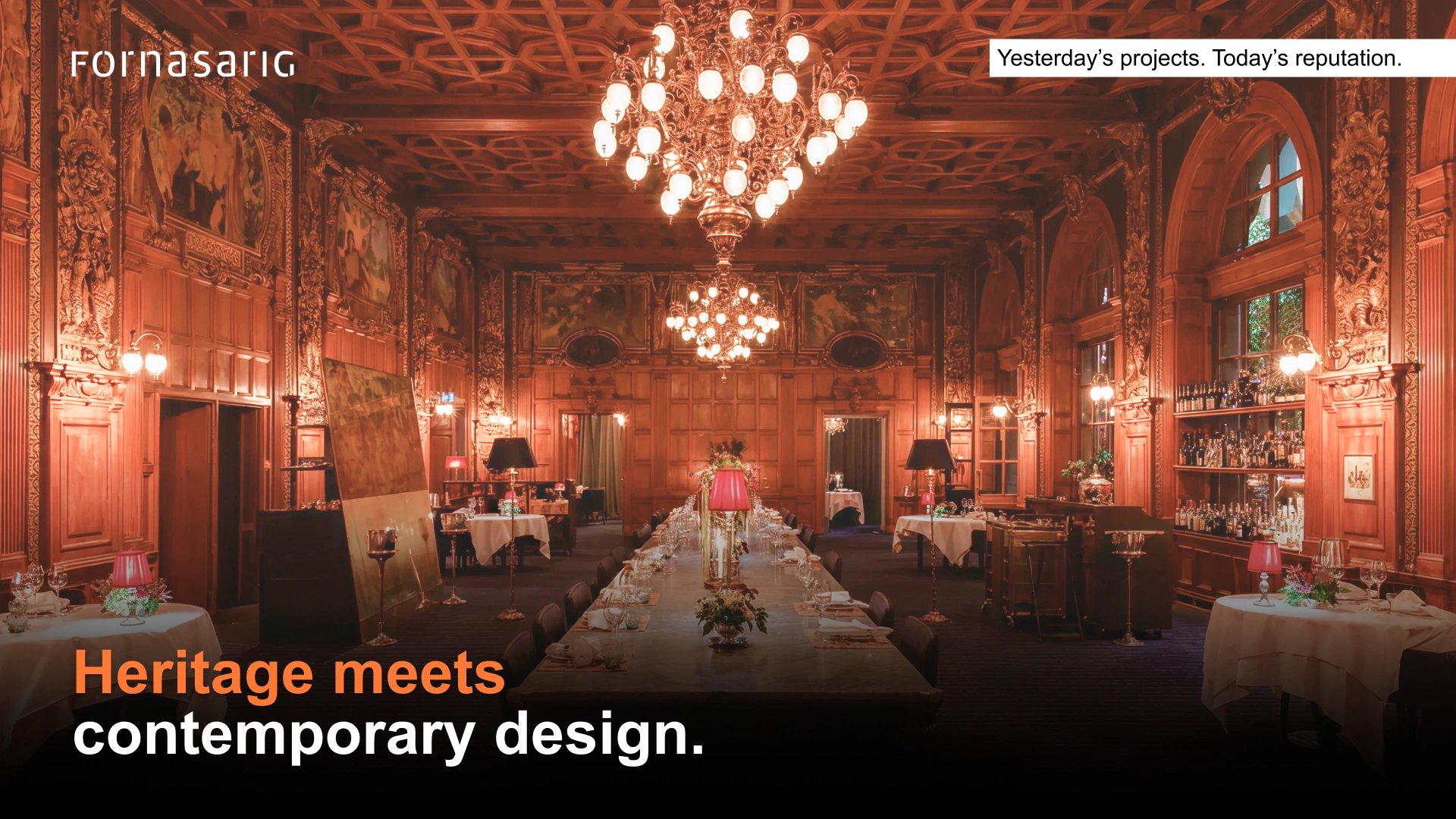
Designing for heritage environments: when history becomes a design constraint
Designing for heritage environments means working inside a delicate balance. In fact, these spaces are never neutral containers. They carry memory, symbolism, and cultural weight, often protected by architectural, artistic, or institutional value. For this reason, every intervention must be measured not only by how it looks, but also by how it behaves over time.
In historic interiors, design cannot dominate. Instead, it must listen first. Furniture is asked to support contemporary use while remaining visually discreet, respectful, and coherent with the surrounding architecture. This becomes even more evident in contract settings, where hospitality, durability, and operational efficiency are non-negotiable requirements.
As a result, heritage projects demand a different design mindset. Rather than adding visual statements, the focus shifts toward proportion, material honesty, and functional clarity. Not by chance, the goal is not contrast for its own sake, but continuity. Contemporary elements are expected to integrate naturally, almost as if they had always belonged to the space.
As many heritage interiors demonstrate, flexibility ultimately defines success. Seating must withstand intensive use, adapt to changing layouts, and remain comfortable across long service cycles. At the same time, however, it must preserve the atmosphere that makes these spaces unique. This is precisely where Fornasarig’s thoughtful contract design becomes a quiet form of respect.
Operakällaren: contemporary seating inside a historic landmark
Operakällaren is a Michelin-starred restaurant located inside Stockholm’s Royal Opera House, one of the city’s most significant historic buildings. The project dates back to an important phase in Fornasarig’s history, when the company was still known as Sedie Friuli, and already active in complex international contract environments.
As often happens in Nordic countries, the client’s request was clear from the start. The interior needed to preserve its historic identity while adopting furnishings aligned with Scandinavian culture. The challenge was therefore twofold: respecting the architectural heritage of the Opera House while introducing seating that reflected a distinctly Nordic design language, sober, precise, and deeply rooted in material honesty.
In this context, furniture could not be expressive or iconic in the conventional sense. It had to be culturally coherent, restrained, and capable of blending into an environment where history is not a backdrop, but the main presence. The seating solution was asked to support fine dining, intensive daily use, and a high level of hospitality, without altering the visual balance of the space.
Rather than competing with history, the project focused on integration. Contemporary design was used as a tool to sustain the space, not to redefine it. This approach allowed Operakällaren to maintain its atmosphere while quietly accommodating modern hospitality standards.
Allround seating system: formal lightness and structural intelligence
For this project, the choice fell on Allround, a seating system designed by Claesson Koivisto Rune for the Fornasarig collection. The studio, formed by three designers who have played a defining role in contemporary Scandinavian design, is known for its ability to combine conceptual clarity with technical precision.
Allround is based on the processing of round-section wooden components. The armchair and two-seater sofa are characterised by continuous wooden elements connected through minimal radii of curvature. The design challenge did not lie in form alone, but in the way the different parts come together. The junctions between components represented the core of the project, requiring both structural intelligence and formal restraint.
The structures are made of solid beech wood, finished with low environmental impact paints. Internally, injected flame-retardant polyurethane foam is applied over a steel frame, ensuring durability and safety for intensive contract use. Seating comfort is achieved through webbing, variable density polyurethane, and polyester fibre filling, allowing the system to perform reliably in hospitality environments.
Slender proportions and essential construction make Allround particularly suitable for heritage interiors. Its presence is discreet, yet clearly contemporary. This balance between innovation and aesthetic control was formally recognised in 2004, when Allround received the Catas Award for its ability to unite technical innovation with an excellent aesthetic result.
Although the model is no longer in production, Allround remains a significant example of how contemporary seating can be designed to endure both functionally and culturally within historic contexts.
Fornasarig: contemporary design with respect for time
For more than a century, Fornasarig has worked at the intersection of craftsmanship, industrial knowledge, and architectural sensitivity. Over time, this background has shaped an approach to contract seating that values longevity, discretion, and contextual awareness above visual assertion.
In heritage projects, this philosophy becomes particularly relevant. Furniture is not treated as a standalone object, but rather as part of a broader spatial ecosystem. Materials, proportions, and construction choices are therefore evaluated for how they interact with existing architecture, and for how they will age within it.
This is because heritage environments do not ask for spectacle. Instead, they ask for understanding. When handled with care, contemporary design can support these spaces without altering their identity. It can enhance usability while preserving atmosphere, and introduce comfort without disrupting balance.
For this reason, designing for heritage is not about looking back. It is about understanding time, its layers, and its rhythms. And designing accordingly.
Toward a culture of material intelligence
Material intelligence is more than a methodology, it is a culture.
It invites designers, architects, and companies to consider how materials shape not only objects, but the environments where people connect, collaborate, and grow. Through this perspective, every project becomes an opportunity to create spaces that are both functional and meaningful.
In a world where contract spaces evolve rapidly, this culture offers a stable foundation. Materials chosen with intention endure changing trends; they support circular processes, reduce environmental impact, and enhance the longevity of design. At the same time, they preserve the emotional clarity that makes a space memorable. The combination of wood, metal, polymer, and fabric becomes a vocabulary capable of expressing values such as hospitality, precision, or concentration.
For Fornasarig, cultivating this culture means working with materials in a way that honours their potential. Each chair is the result of research, dialogue, and craftsmanship; a synthesis of structure, comfort, and emotion. From the warmth of FSC-certified wood to the resilience of reinforced polyolefin resin, from the precision of steel rod to the softness of upholstery, every element is selected for what it can contribute to the overall experience.
Consequently, material intelligence guides not only how chairs are built, but how spaces are imagined. It encourages designers to think beyond aesthetics, to consider how matter influences posture, interaction, acoustics, and even the emotional tone of a room. In this sense, materials become partners in the creative process, shaping environments with quiet authority.
Ultimately, embracing material intelligence means recognising that the beauty of a space lies in more than its appearance.
It lies in how it supports people.
In how it adapts.
In how it endures.
This is why Fornasarig treats materials as narrative tools and not simply components.
By giving matter a voice, the company shapes spaces that are clear, elegant, and human spaces where design speaks softly, but with intention.
This is the reason why material intelligence turns furniture into architecture and architecture into experience.